
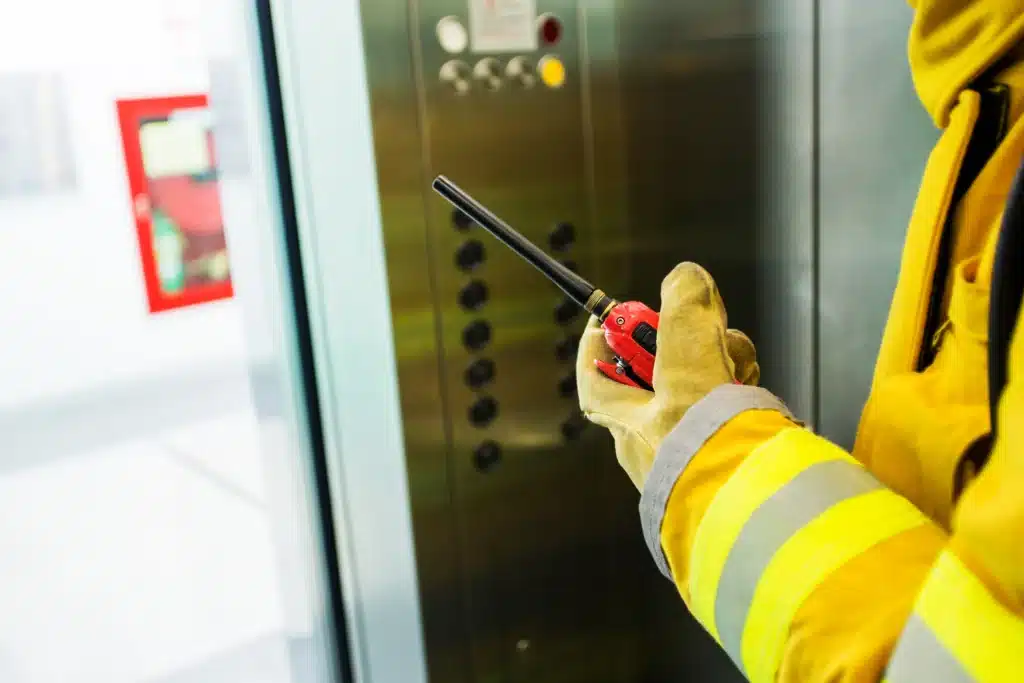
A practical guide to the compliance gaps, documentation failures, and overlooked code requirements that turn routine elevator maintenance into building-owner liability.
If you own or manage a building, you probably think of your elevator service contract as a maintenance line item. It’s also, whether anyone has framed it this way for you or not, the single most important liability document tied to that piece of equipment. When an elevator incident ends up in front of an inspector, an insurance adjuster, or a plaintiff’s attorney, the first question is rarely about the equipment itself. It’s about the paperwork: was there a maintenance program, was it followed, and can you prove it.
That distinction matters because your elevator liability in most jurisdictions doesn’t hinge on whether the equipment failed. It hinges on whether the failure was foreseeable and whether you had a documented, functioning system in place to catch it. Equipment fails. Courts and code officials are far less forgiving of owners who can’t show they were actively managing that risk.
This guide walks through the specific compliance and documentation gaps that create real exposure for you as a building owner or facility manager, most of which have nothing to do with the mechanical condition of your elevator itself.
The Maintenance Control Program Is the Document Everyone Forgets to Check
Under the 2000 and later editions of ASME A17.1/CSA B44, the Safety Code for Elevators and Escalators, every conveyance — elevators, escalators, moving walks, dumbwaiters, material lifts — is required to have a written Maintenance Control Program, or MCP, governed by Section 8.6 of the code. If you haven’t seen yours, you’re not alone — most building owners haven’t.
The MCP isn’t generic boilerplate. It’s supposed to be written around the specific equipment in your building — make, model, age, configuration — and it has to define the examinations, tests, cleaning, lubrication, and adjustments required for each unit, along with the time intervals for those tasks based on equipment type, age, usage, and manufacturer recommendations. A one-size-fits-all maintenance schedule applied across your entire portfolio of conveyances doesn’t satisfy this requirement, even if the work is actually getting done.
Here’s the part that tends to catch owners off guard: your contractor writes the MCP and performs the work, but the certificate of operation belongs to the equipment, and you, as the building owner, are the party of record. When an inspector, insurer, or attorney goes looking for documentation after an incident, they start with you, not your maintenance vendor. A missing or incomplete MCP is one of the most frequently cited violations in elevator compliance inspections nationwide, and it reads to an AHJ as direct evidence that proper maintenance isn’t being performed, independent of the equipment’s actual condition.
“A missing or incomplete MCP doesn’t just fail an inspection — it signals to the AHJ, and later to a plaintiff’s attorney, that you never had a system in the first place.”
Practical takeaway: ask your service contractor for a copy of the current MCP for every conveyance in your building. If it doesn’t exist, or if it’s a generic template rather than equipment-specific, that’s a compliance gap worth closing before it becomes a discovery item.
Regulatory compliance services help building owners identify exactly these documentation gaps before they become inspection or liability issues.
Recordkeeping Requirements Are More Specific Than Most Owners Realize
ASME A17.1/CSA B44 Section 8.6.1.4 requires that maintenance records — dates, scope of work performed, parts replaced, and observations — be retained for a minimum of five years and kept available on site, either physically in the machine room or accessible electronically, depending on local AHJ requirements. Separately, a callback log must be maintained that documents every reported trouble call, including the date, time, description of the issue, and the corrective action taken.
In practice, this means you need two different documentation streams to exist simultaneously: the routine maintenance log showing scheduled work was performed, and the callback log showing how your building responded when something went wrong between scheduled visits. If you only have one of these streams, or if you rely entirely on your vendor’s internal system without keeping a building-side copy, you’re exposed if that vendor relationship ends or the records aren’t readily producible.
“Readily accessible” is doing real work in that requirement. Records that exist somewhere in a vendor’s database but take two weeks and three phone calls to retrieve don’t meet the standard of being available on demand. If an inspector or insurer asks you for five years of maintenance history and it takes your team a month to assemble it, that delay itself becomes part of the record.
Code Edition Confusion Is a Bigger Risk Than Most Owners Assume
There is no single national elevator code. Each state, city, or province adopts a specific edition of ASME A17.1 or CSA B44 into its building code, often with local amendments layered on top. As of 2026, the most recently published edition is A17.1-2025, but the working edition actively enforced in most U.S. jurisdictions is still A17.1-2022 or A17.1-2019. Compliance with an older edition won’t automatically satisfy an AHJ that has since adopted a newer one.
This creates a specific liability trap if you operate across multiple jurisdictions or haven’t confirmed which edition your local AHJ currently enforces. A maintenance program that was fully compliant when it was written can become non-compliant purely because the local code adoption changed underneath it, with no change to your building or equipment at all.
Local amendments compound this. Some jurisdictions, including several major cities, layer stricter inspection frequency and documentation requirements on top of the base ASME code. If you’re assuming the national code is the full picture without checking local amendments, you’re working from an incomplete compliance baseline.
- Confirm the exact code edition (and year) your local AHJ currently enforces — not the edition your equipment was installed under.
- Check for local amendments layered on top of the base ASME A17.1/CSA B44 code, particularly around inspection frequency and documentation.
- Re-verify code edition compliance after any ownership transition, refinancing, or insurance renewal — these are the moments code adoption gaps tend to surface.
The 2025 Cybersecurity Requirement Most Owners Haven’t Heard Of
ASME A17.1-2025 introduced something new to elevator code: cybersecurity requirements. This is a direct response to networked elevator control systems and destination dispatch platforms, which are now standard in most mid-rise and high-rise commercial buildings. Under the new edition, if your building has connected elevator control systems, you’re expected to document and maintain security review records alongside your traditional mechanical and electrical maintenance records.
If you have modernized or networked elevator systems, this is a genuinely new compliance category for you, not an extension of an existing one. It has nothing to do with how well your brakes or governor are maintained, and everything to do with whether your elevator controls are documented as part of an IT or OT security review. If you modernized your elevator systems in the last several years for energy efficiency or remote monitoring, you may have inadvertently put yourself into this compliance category without realizing it applies to you.
As part of broader operational assessments, connected building systems should now be evaluated for both mechanical reliability and emerging cybersecurity documentation requirements.
ADA Liability Doesn’t Wait for an Accident — It Starts the Moment the Elevator Goes Down
This is the gap that tends to surprise building owners most. Under the ADA Title III Technical Assistance Manual, an out-of-service elevator that blocks an accessible route is, on its own, a documentable accessibility violation, separate and apart from any injury or mechanical failure claim. The Department of Justice’s own guidance states plainly that inoperable or out-of-service equipment doesn’t satisfy the requirement to keep a facility accessible, and that the obligation is violated specifically when repairs aren’t made promptly or when inadequate maintenance causes repeated, persistent outages.
Read that carefully: occasional mechanical failure is recognized and tolerated. Repeated failure, or a slow repair response on your part, is what converts a maintenance issue into an ADA compliance violation. If you have one elevator serving upper floors and it goes down for a week while waiting on a part, with no interim accommodation offered, you have exposure that exists independently of whether anyone was hurt.
This matters more in 2026 than it has in years past. Pro se ADA filings, where plaintiffs represent themselves, now account for roughly 40% of federal Title III filings, a shift driven partly by easier access to legal templates and AI-assisted complaint drafting. The bar to file has dropped. An elevator outage that drags on, particularly if you have no alternative accessible route, is exactly the kind of fact pattern that generates a filing without requiring an injury at all.
“Repeated outages and slow repair response — not the mechanical failure itself — are what the DOJ’s own guidance identifies as the ADA violation.”
Practical takeaway: if your elevator serves the only accessible route to upper floors, have a written interim accommodation plan ready for extended outages, and treat repeated breakdowns of the same unit as a compliance flag, not just a maintenance nuisance.
Insurance and Litigation Are Now Looking at the Same Documents Inspectors Look At
Elevator safety compliance in 2026 is more scrutinized by insurers and more frequently referenced in litigation than it was even a few years ago, and it’s increasingly likely to surface during ownership transitions, refinancing, and routine building audits. The documents that satisfy an AHJ inspection — your MCP, maintenance log, callback log, and code-edition confirmation — are the same documents an insurer’s underwriter or a plaintiff’s attorney will request from you after an incident.
This convergence matters because it means there’s no longer a meaningful distinction between “compliance documentation” and “litigation defense documentation.” They’re the same paper trail. If you treat MCP compliance as a box-checking exercise for the annual inspection, rather than as the foundation of your liability defense, you’re underinvesting in the one thing most likely to determine the outcome of a claim.
Insurers underwriting commercial property and general liability policies are increasingly asking for elevator-specific documentation at renewal: current MCP, inspection certificates, and callback history. If you can’t produce this cleanly, you may start seeing it reflected in your premiums and underwriting friction, independent of your claims history.
Common Compliance Gaps and Where They Surface
The table below summarizes the gaps covered in this guide, where they’re most likely to be discovered, and the practical fix for each one.
| Compliance Gap | Where It Surfaces | Practical Fix |
|---|---|---|
| Missing or generic MCP (ASME A17.1 §8.6) | Routine AHJ inspection; post-incident discovery | Request equipment-specific MCP from contractor in writing |
| Incomplete 5-year maintenance/callback log (§8.6.1.4) | Insurance renewal; litigation document request | Maintain a building-side copy, not just vendor records |
| Wrong code edition applied | Ownership transition; refinancing; AHJ audit | Confirm current AHJ-enforced edition annually |
| No cybersecurity documentation for networked controls (A17.1-2025) | Modernization review; post-2026 AHJ inspections | Add security review records to maintenance file |
| Repeated outages with no accommodation plan | ADA Title III complaint or pro se filing | Written interim accommodation plan for extended outages |
Source: ASME A17.1/CSA B44 Sections 8.6 and 8.6.1.4; ADA Title III Technical Assistance Manual, III-4.4000.
Where an Outside Review Adds the Most Value
Most of these gaps aren’t visible from your seat as the building owner, because the relevant documents live with your service contractor, the AHJ, or a code book you’ve probably never had reason to open. An independent facilities consulting review typically focuses on a short list of questions that, between them, surface almost every gap covered above:
- Does an equipment-specific MCP exist for every conveyance in your building, or is it a generic template?
- Could you produce five years of maintenance and callback records within 24 hours, not 24 days?
- Which code edition does your local AHJ currently enforce, and does your program match it?
- If you have networked or modernized controls, does a cybersecurity documentation record exist for them?
- Do you have a written plan for extended outages on elevators serving your only accessible route?
None of these require a mechanical inspection to answer. They require pulling documents and comparing them against what the code actually requires — which is exactly the kind of review that’s cheap to do proactively and expensive to skip.
The Bottom Line
Your elevator liability rarely starts with a mechanical failure. It starts with a missing document, an outdated code reference, or an outage that ran longer than it should have because no one treated it as a compliance issue rather than a maintenance inconvenience. The equipment itself is usually the least controllable variable here. The paperwork is entirely within your control, and it’s the part that determines how an incident, an inspection, or an insurance renewal actually plays out for you.
If you haven’t reviewed your building’s Maintenance Control Program, confirmed your AHJ’s current code edition, or checked whether your maintenance records could be produced on short notice, that review is worth doing before an inspector, insurer, or attorney asks for it first.
Let Us Take This Off Your Plate
Here’s the honest version of all this: you’re already busy running your building, and an elevator code book isn’t exactly weekend reading. That’s the gap Left Coast Facilities Consulting is built to close for you.
We’ll sit down with your maintenance records, your MCP, and your service contracts, and tell you plainly where you stand — not in code-speak, in plain language you can act on. If something’s missing, we’ll help you get it in place before it becomes a problem instead of after. And if your paperwork’s already in good shape, we’ll tell you that too, so you’re not paying for work you don’t need.
If you’d rather find out about these gaps from us than from an inspector, an insurer, or an attorney, reach out to Left Coast Facilities Consulting for a no-obligation building review. We’d genuinely like to help you get ahead of this.
Sources
- ASME A17.1/CSA B44 — Safety Code for Elevators and Escalators, Section 8.6 (Maintenance Control Program requirements)
- ADA Title III Technical Assistance Manual, III-4.4000 (DOJ guidance on inoperable equipment and accessible routes)
- ANSI Blog — ASME A17.1-2025: Safety Code for Elevators and Escalators
- Seyfarth Shaw — ADA Title III Practice Update, 2026