
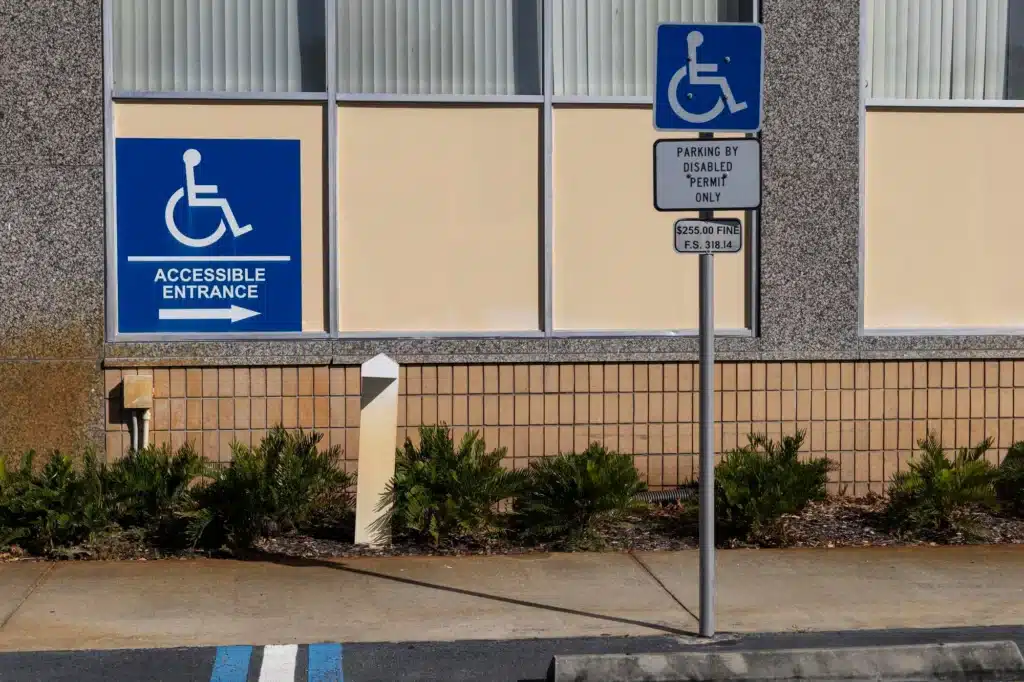
Businesses got hit with 8,667 ADA lawsuits in federal court in 2025 alone. That’s more than three times the number filed back in 2013. Property owners rarely see these cases coming, and a clean track record offers no protection once a claim lands on your desk.
Getting ADA for facilities right has become one of the fastest growing sources of legal exposure for business owners across the country. Most don’t realize it until it’s too late.
Documentation matters more than most owners assume. A written plan, what was found, what’s been fixed, what’s scheduled next, and why, can serve as proof of a good-faith effort to comply if a claim is ever filed. Owners without that paper trail are left arguing their case from memory.
A structured assessment from someone who knows what plaintiffs’ attorneys and their inspectors look for takes the guesswork out of this.
Know Exactly What Your ADA Exposure Could Cost You
See your potential Disabled Access Credit and Barrier Removal Deduction before you spend a dollar on compliance.
ADA Tax Credit & Deduction CalculatorWhich Facilities Actually Fall Under the ADA?
One common source of confusion is figuring out whether a property is covered, and under which part of the law. Here’s how the U.S. Access Board breaks down coverage:- State and local government facilities (Title II). Schools, courthouses, public housing, and other government buildings must ensure “program accessibility” in new construction and alterations.
- Places of public accommodation and commercial facilities (Title III). This is where most private business owners land. It covers about twelve categories, including retail stores, restaurants, hotels, theaters, medical offices, office buildings, factories, and warehouses.
- Transportation facilities. Bus stops, rail stations, and similar facilities have their own accessibility rules.
- Exemptions. Religious organizations and genuinely private clubs are generally exempt from ADA Standards, though state or local access codes may still apply to them.
Title II vs. Title III at a Glance
| Feature | Title II | Title III |
|---|---|---|
| Who it covers | State and local government entities | Private businesses open to the public, plus commercial facilities |
| Core standard | Program accessibility for services as a whole, not every single facility | Removal of barriers in existing facilities when readily achievable |
| Who enforces it | DOJ, plus private lawsuits | Private lawsuits, DOJ in pattern-or-practice cases |
| Typical examples | City hall, public schools, DMV offices, public transit stops | Retail stores, restaurants, hotels, medical offices, warehouses |
| Monetary damages | Generally limited to injunctive relief and fees federally | Generally limited to injunctive relief and fees federally, though some states allow damages |
The Lawsuit Landscape Is Bigger Than Most Owners Realize
The Americans with Disabilities Act has been federal law since 1990, but enforcement has changed a lot in the past decade. Complaints that used to be handled quietly are now often filed as formal lawsuits. Sometimes the same plaintiffs and law firms target dozens or even hundreds of businesses in one region. A few things make this risk different from other compliance issues:- No advance warning is required. Most regulatory violations come with a chance to fix the problem first. ADA claims don’t work that way. A missing grab bar, a narrow doorway, or a parking space without the right signage can trigger a lawsuit with no warning at all.
- Some areas draw more attention than others. Restrooms, accessible parking counts and signage, entrance thresholds, and open office layouts with tight walkways are consistently among the most cited problems in ADA claims. They’re also the easiest for an inspector or a plaintiff to spot in a single visit.
- Both physical and digital spaces count. ADA obligations aren’t limited to ramps and restrooms. Websites, online ordering systems, and even PDF menus have become the subject of lawsuits under the same law. Website accessibility cases made up 36% of all federal ADA lawsuits in 2025, up from 28% the year before.
- Not knowing isn’t a defense. Courts have consistently ruled that a business’s lack of awareness doesn’t shield it from liability. Many owners are surprised to learn that a building put up decades ago, or renovated by a past tenant, was never actually brought up to current accessibility standards.
- Costs add up fast. Beyond the original complaint, businesses often face attorney’s fees on both sides, the cost of fixing the problem, and a reputation hit that can outlast the legal case itself.
The “Grandfathered” Myth That Keeps Costing Owners
The most common misunderstanding about ADA for facilities is the belief that older buildings are exempt simply because they were built before the law existed. They aren’t. The ADA is a civil rights law, not a building code. That means it doesn’t work the way most construction regulations do. A typical building code might grandfather older construction until a renovation triggers an upgrade. The ADA instead requires existing public accommodations to remove barriers whenever doing so is “readily achievable,” meaning it can be done easily and without much cost. There’s no need to wait for a remodel. The obligation already exists. This is why a facility with a decades-old floor plan, original signage, or a restroom that hasn’t been touched since a past renovation can still lead to a valid legal claim today, even if nothing about the space has changed recently. Two details make this harder to navigate without help:- “Readily achievable” isn’t a fixed bar. Courts look at factors like the cost of the fix, the facility’s financial resources, and the size of the business. What’s readily achievable for a national chain may not be for a single-location shop. But the reverse is also true. A well-resourced business can’t claim the same exemptions a small one might.
- A “safe harbor” protects some older elements, but not all of them. Elements built or altered before March 15, 2012 that met the 1991 ADA Standards generally don’t need to be redone to meet the newer 2010 Standards. But if an element never met the 1991 Standards in the first place, or falls into a handful of categories the safe harbor doesn’t cover, like recreational features and pools, it still has to meet the current standard.
Why a Passed Inspection Doesn’t Protect You
Here’s a detail that catches even careful owners off guard. The ADA has no plan review or permitting process. Unlike a fire code or a building permit, no government inspector signs off and certifies a facility as ADA compliant. The ADA is enforced only through complaints and lawsuits, brought by individuals, advocacy groups, or the Department of Justice. It isn’t enforced through the inspection process that governs most other building requirements, as the U.S. Access Board explains. That means a certificate of occupancy, a passed fire inspection, or a local building permit says nothing about ADA compliance. Some local building departments even add a disclaimer stating that their approval doesn’t cover ADA requirements at all. It also means state and local access codes don’t replace federal ADA obligations. They stack on top of them. Whichever requirement is stricter, state, local, or federal, is the one that applies. Owners in states with strong accessibility codes and active enforcement, California being the best known example, often face far more demand letters and lawsuits than the national average. California led the country with 3,252 federal ADA lawsuits in 2025, more than twice as many as second-place Florida. That’s because state law adds its own right to sue on top of federal exposure. This matters even for facilities outside California, since a business with locations in multiple states can pick up that exposure the moment it opens a site there. Businesses with a California location should also know about the Certified Access Specialist, or CASp, program. A CASp is a state-authorized professional trained to evaluate a site against both ADA and California accessibility rules. A CASp report carries a real legal benefit: it may qualify a business for a stay and an early evaluation conference if a construction-related accessibility claim is filed, which can change how that lawsuit plays out.Compliance Costs Can Be Offset
Fixing accessibility barriers is often treated as pure expense, but two federal tax incentives exist to help cover that cost.- The Disabled Access Credit (IRS Form 8826). Eligible small businesses can claim a tax credit worth up to 50% of qualifying accessibility costs, within certain limits.
- The Section 190 Barrier Removal Deduction. Businesses of any size can deduct up to $15,000 per year in qualified costs for removing architectural barriers.
ADA Tax Credit & Deduction Calculator
Estimate your potential first-year tax benefit under the Disabled Access Credit (IRS Form 8826 / Section 44) and the Section 190 Barrier Removal Deduction for ADA compliance costs.
Estimate for general informational purposes only, not tax advice. Actual eligibility and amounts depend on your full tax situation — consult a CPA or tax advisor before filing. Based on IRC Sections 44 and 190 as of 2026.
Why “We’ve Never Had a Complaint” Isn’t Reassuring
A common misconception is that a clean complaint history means a clean compliance record. In reality, many owners only learn a violation exists when they’re served with paperwork. Aging facilities, additions built without proper permitting, and small details like signage height, door pressure, or the slope of a threshold can all be enough to trigger a claim. Compliance also isn’t a one-time achievement. Standards get updated, businesses change their layouts, equipment gets moved, and what passed inspection five years ago may no longer meet current requirements.Real Cases That Show What’s at Stake
These aren’t hypothetical risks. They’ve played out in real court cases and DOJ settlements, at every size of business. Chicago Cubs / Wrigley Field. In 2022, the DOJ sued the Chicago Cubs over a $550 million renovation of Wrigley Field, alleging the project removed the best wheelchair-accessible seating, failed to add wheelchair spots in new premium areas, and left architectural barriers in place elsewhere in the stadium even though fixing them was readily achievable. The case settled in 2024 with the Cubs agreeing to add wheelchair seating, fix circulation paths, and improve accessible parking and shuttle service. The lesson: even a major, well-funded renovation can create new ADA problems if accessibility isn’t part of the design process from the start. Robles v. Domino’s Pizza. A blind customer sued Domino’s after its website and app wouldn’t work with his screen-reading software, blocking him from ordering food. The Ninth Circuit ruled in 2019 that the ADA applies to a business’s website and app when they connect customers to a physical store, and the Supreme Court declined to hear Domino’s appeal. The case has since become the standard reference point for digital accessibility lawsuits nationwide. The lesson: a facility’s ADA exposure doesn’t stop at its front door. Little General Store. A 48-location regional convenience store chain in West Virginia reached a settlement agreement with the DOJ after a single complaint about one store triggered a broader investigation into all of its locations. The agreement required the chain to remove architectural barriers across its stores wherever doing so was readily achievable. The lesson: one complaint about one location can turn into a review of an entire portfolio.What Proactive Owners Are Doing Differently
Businesses that avoid this exposure tend to share one habit. They treat accessibility review as a routine part of facilities management, not something they scramble to fix after a legal letter arrives. That usually looks like regular operational assessments built into the normal facilities calendar, not a one-off reaction. In practice, that means:- Regular facility walkthroughs checked against current ADA Standards, not assumptions or outdated blueprints
- Documentation of existing conditions and any repairs made, which matters if a claim is ever filed
- A clear plan for fixing problems in order of risk and cost, instead of an all-at-once scramble
- Attention to both the physical space and any public-facing website or app
Barrier Removal Priority Checklist
When a facility can’t fix every issue at once, federal guidance lays out a priority order for tackling barrier removal. Following it isn’t just efficient. It matches how courts and regulators judge a facility’s good-faith effort.1
Getting in the door. Accessible parking, curb ramps, and a usable path from the street or lot to the entrance. This comes first because nothing else matters if a customer can’t get inside.
2
Reaching the goods and services. Clear aisles, usable sales counters, and displays that a wheelchair user or someone with a mobility aid can actually reach.
3
Accessible restrooms. Grab bars, clear floor space, and door hardware that meets current standards.
4
Everything else. Any remaining barriers not covered above, addressed as budget allows.