

The Clean Buildings Performance Standard (CBPS), signed into law in 2019 and expanded in 2022 and 2023, is Washington State’s framework for reducing energy use and emissions in commercial and multifamily buildings.
The goal is simple: lower operating costs, reduce fossil fuel consumption, and improve building performance across covered properties.
The program also includes Tier 1 and Tier 2 incentives to encourage early compliance and investment in energy efficiency upgrades, supported by structured capex project management to ensure measurable results.
See Exactly Where Your Building Stands
Enter your building type and square footage to find your CBPS tier and compliance deadline in seconds.
CBPS Tier & Deadline CalculatorKey Takeaways
-
Who’s covered: Tier 1 non-residential ≥50,000 sq ft; Tier 2 20,000–50,000 sq ft (plus multifamily >20,000 sq ft).
-
Key dates: Tier 1 >220k June 1, 2026 · 90k–220k June 1, 2027 · 50k–90k June 1, 2028. Tier 2 July 1, 2027.
-
What WA expects: Use less energy and prove it—benchmark, plan, improve, submit.
-
Capex that moves the needle: HVAC & controls, LEDs + smart lighting, insulation/envelope, scheduling/VFDs—prioritize by ROI + incentives.
-
Do this next (30/60/90):
-
30 days: Gather 24 months of utility data; benchmark in ENERGY STAR Portfolio Manager; assign an internal owner.
-
60 days: Draft Energy Management Plan + O&M checklist; scope quick wins; apply for utility rebates.
-
90 days: Approve capital projects, kick off implementation, and set your Clean Buildings Portal submission timeline.
-
-
Keep these docs: Benchmark exports, EMP, O&M logs, project invoices, M&V/savings notes, submission receipts.
-
If you wait: Fines, rush premiums, missed incentives, higher operating costs.
-
Upside: Lower utility bills, steadier operations, better indoor air, smaller footprint, stronger asset value.
Recent CBPS Developments (2026)
The Clean Buildings Performance Standard continues to evolve as the first Tier 1 deadline approaches. Here’s what’s changed recently:
- 2026 CBPS Integrated Document released. Commerce has published an updated edition of the standard incorporating all recent rule changes — now the definitive reference for compliance pathways and exemptions.
- New compliance pathway options. Alongside the original four Tier 1 pathways, owners with all efficiency measures already implemented can now apply for “conditional compliance,” which defers final performance verification while requiring annual reporting.
- Tier 2 Early Adopter Incentive Program launched July 1, 2025. $150 million is available to Tier 2 building owners (20,000–50,000 sq ft, plus multifamily over 20,000 sq ft) who start compliance early, funded through participating utilities on a first-come, first-served basis.
- District Energy Committee formed. Under SSB 6003, Commerce is standing up a new committee to explore district energy systems for state campus decarbonization.
- $29 million awarded statewide in September 2026. Commerce distributed funding across 144 energy efficiency projects through four grant programs, funded by Washington’s Climate Commitment Act.
Does CBPS Apply to You?
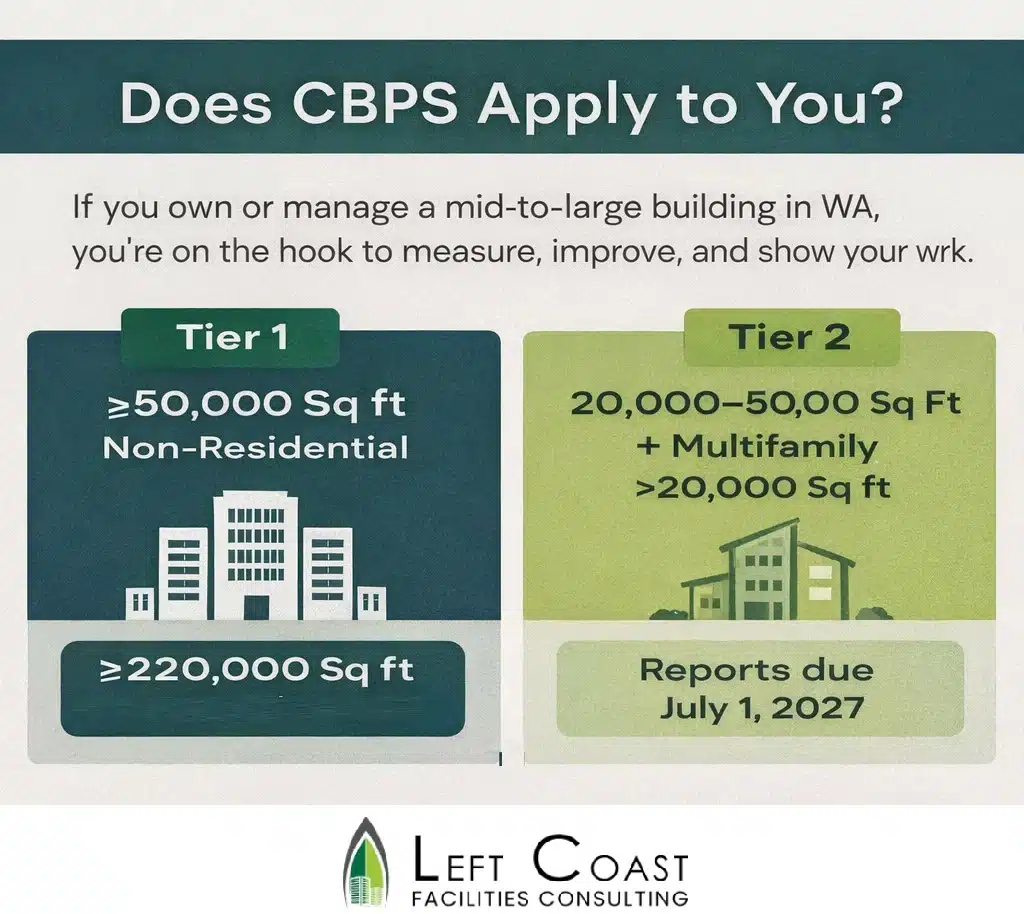
Tier 1 (≥50,000 sq ft non-residential)
-
>220,000 sq ft: reports due June 1, 2026
-
90,000–200,000 sq ft: reports due June 1, 2027
-
50,000–90,000 sq ft: reports due June 1, 2028
Tier 2 (20,000–50,000 sq ft + multifamily >20,000 sq ft)
-
Reports due July 1, 2027
If you own or manage a mid-to-large building in WA, you’re on the hook to measure, improve, and show your work.
Tier 1 applies to buildings over 50,000 sq ft, while Tier 2 covers buildings between 20,000 and 50,000 sq ft, including certain multifamily properties.
Both tiers require benchmarking, energy management planning, and ongoing operations and maintenance practices to maintain compliance.
CBPS Tier & Deadline Calculator
Enter your building type and gross square footage (excluding parking) to find your CBPS tier and exact reporting deadline.
This tool applies the general square-footage rules published by WA Department of Commerce. Official tier determination, exemptions, and extensions should be confirmed via the Clean Buildings Portal.
What the State Expects
For all covered buildings:
-
Benchmark & verify in ENERGY STAR Portfolio Manager, then submit via the Clean Buildings Portal.
-
Create an Energy Management Plan (EMP) and Operations & Maintenance (O&M) practices that match your building.
-
Hit performance targets or document improvements that get you there on a credible timeline.
Tier 2 emphasis:
-
Benchmarking: Know your baseline (how you’re doing now).
-
EMP: Decide how you’ll improve (projects, timelines, people).
-
O&M: Keep systems efficient over time (routines so savings stick).
What Are the Requirements for Building Owners?
Every covered building must benchmark energy use in ENERGY STAR Portfolio Manager, create an Energy Management Plan (EMP), and implement an Operations & Maintenance (O&M) program. Tier 1 buildings must also meet one of four compliance pathways under ASHRAE Standard 100-2018:
- Energy Use Intensity (EUI) Target. The simplest pathway if your building’s measured EUI already meets or falls below the state-established target for its building type.
- Investment Criteria. Conduct an ASHRAE Level 2 energy audit and implement cost-effective efficiency measures, using one of four methods: an optimized bundle, installing all measures with a simple payback, documenting that no measures have a simple payback, or a custom bundle.
- Minimum Energy Use Reduction. Demonstrate a measured, weather-normalized EUI reduction of at least 15% from an established baseline.
- Space Heating Electrification. Replace fossil fuel space conditioning equipment with electric heat pumps within five years of the compliance deadline.
Building owners can also apply for “conditional compliance” if all efficiency measures are already implemented but performance verification is still pending, with annual reporting required.
Exemptions
Buildings may qualify for exemption if one of the following applies to more than 50% of the floor area: no certificate of occupancy, no physical occupancy, unconditioned or semi-heated space, manufacturing/industrial use (Factory Group F or High Hazard Group H), agricultural operations, scheduled demolition, financial hardship, or national security concerns.
“Compliance light” exemptions are also available for buildings with historic integrity concerns or significant loss in assessed value — these still require benchmarking, an EMP, and an O&M program, but not a performance target.
Exemption applications must be submitted up to three years before the compliance deadline, and certificates are valid for the current five-year compliance cycle only.
Extensions
Two-year extensions are available for owners who apply between six months before and six months after their compliance deadline. Qualifying circumstances include recent ownership changes, financial constraints, new construction or major renovations, circumstances beyond reasonable control, or needing additional time to complete EMP/O&M work or hit a performance target after the other requirements are already met.
Compliance and Reporting Obligations
Once you’ve got your numbers, everything gets submitted through the Clean Buildings Portal — that’s where Commerce verifies your building’s details and collects your compliance documentation.
Tier 2 buildings are working through three things at this stage: benchmarking (tracking your energy use against similar buildings so you can see where you’re losing ground), an Energy Management Plan (a real plan for closing that gap, not just a memo), and an Operations & Maintenance program that keeps your systems running the way they’re supposed to—regular checks, timely upgrades, and staff who actually know what they’re looking at.
Potential Penalties for Non-Compliance
Building owners who miss their compliance deadline face administrative penalties of up to $5,000 plus $1.50 per square foot of gross floor area, assessed annually until the building comes into compliance. The Washington State Department of Commerce has stated that its “primary goal is to foster compliance, not impose penalties,” and owners who receive an approved extension within six months of their deadline won’t be penalized as long as they meet the requirements within that extension window.
Owners who can’t yet meet their obligations can also submit a noncompliance mitigation plan rather than simply accruing penalties, outlining the steps and timeline to reach compliance. To avoid penalties altogether, make sure you complete your energy assessments, implement efficiency measures, and submit your benchmarking, EMP, and performance data on time through the Clean Buildings Portal.
Strategies for Implementing Clean Building Practices
The owners who get through this smoothly treat it like a normal capital planning cycle, not a compliance fire drill. Start with the cheap stuff — a lighting retrofit, tighter controls scheduling, sealing up the envelope — and you’ll usually see payback inside a few years while your EUI moves in the right direction almost immediately.
From there, an ASHRAE Level 2 audit will tell you which bigger-ticket items (HVAC replacement, electrification) actually pencil out for your specific building, instead of guessing. Bundle those projects with the incentive programs below so you’re not paying full price, and loop in whoever actually runs the building day to day early on — an Energy Management Plan only works if the facilities team is the one following it.
Resources and Assistance Available to You
Smart Buildings Center Clean Buildings Helpdesk — A free helpdesk for building owners and facility managers working through benchmarking, EMP development, and pathway selection.
Monthly Office Hours — Commerce hosts open Q&A sessions on the fourth Tuesday of every month, 10–11 a.m. PT, via Zoom.
CBPS Webinars — Live training sessions run throughout the year, with recordings of past sessions available for anyone who can’t attend live.
BEACON Fellowship Project — The Building Efficiency and Clean Operations Network, developed with the Smart Buildings Center Education Program, offers hands-on technical assistance for building teams.
CBPS Document Library — A full library of FAQs, templates, and the ASHRAE Standard 100-2018 reference material building owners need for compliance.
Direct Support — Reach Commerce directly through the CBPS Customer Support Portal or by emailing Buildings@Commerce.wa.gov.
Beyond state resources, industry organizations, trade associations, and experienced consultants like Left Coast Facilities Consulting can help you interpret these requirements for your specific building and put a compliance timeline in place.
Benefits of Complying with the Clean Building Performance Standard
Compliance isn’t just a box to check — done right, it pays for itself. Here’s what building owners actually get out of it:
- Lower utility bills. Efficiency upgrades that get you to your EUI target also cut your operating costs, often by a meaningful margin.
- Fewer surprises down the road. A building that’s already benchmarked and audited isn’t caught flat-footed by the next round of energy code changes.
- Better tenant experience. Upgraded HVAC and ventilation tend to mean better indoor air quality, which tenants notice.
- Access to real money. Early movers get first pick of the Early Adopter incentive funds and utility rebates — those pools shrink as more buildings apply.
- A cleaner story for buyers and lenders. Documented compliance is increasingly something appraisers, lenders, and buyers ask about during due diligence.
None of that requires treating this as anything more than good building management with a deadline attached.
Grants, Incentives and Training Opportunities
One of the most overlooked aspects of the Clean Buildings Performance Standard is the financial support available to building owners. Washington State has allocated significant funding to help offset compliance costs and encourage early action, meaning you don’t have to shoulder the full burden of upgrades alone.
Financial Incentives and Grants
Several programs are available to reduce upfront costs and improve ROI on energy efficiency investments:
- Tier 1 Early Adopter Incentive Program
Non-residential, hotel, motel, and dormitory buildings over 50,000 sq ft that demonstrate early compliance can qualify for a one-time incentive payment, drawn from a $75 million total fund. - Tier 2 Early Adopter Incentive Program
Launched July 1, 2025 with $150 million allocated. Buildings 20,000–50,000 sq ft and multifamily buildings over 20,000 sq ft can apply through the Clean Buildings Portal; incentives are paid by participating utilities (utilities with more than 25,000 customers are required to participate) on a first-come, first-served basis. - Clean Buildings Performance Grants
Competitive funding for both private and public buildings to support energy efficiency upgrades, reduce emissions, and lower operating costs. - Energy Efficiency Retrofits Grants
Competitive funding for public buildings — schools, hospitals, community centers, affordable housing, and wastewater facilities. - State Project Improvement (SPI) Grants
Available to state agencies for building redesigns that prioritize energy efficiency.
In September 2026, Commerce distributed more than $29 million across 144 energy efficiency projects statewide through these programs, funded by Washington’s Climate Commitment Act.
Training and Capability Building
Compliance isn’t just about upgrades—it’s about managing performance over time. That’s where training becomes critical.
- Qualified Energy Manager (QEM) Training
This program equips building owners and operators with the knowledge to manage energy performance, maintain compliance and identify ongoing efficiency opportunities. - BEACON Fellowship Project
Hands-on technical assistance and training through the Building Efficiency and Clean Operations Network, run in partnership with the Smart Buildings Center Education Program. - Free Clean Buildings Helpdesk
One-on-one support for benchmarking, EMP development, and pathway selection questions, plus monthly office hours and live webinars throughout the year.
By combining available funding with the right operational knowledge, building owners can turn compliance from a cost centre into a long-term performance advantage.
Not sure where your building stands?